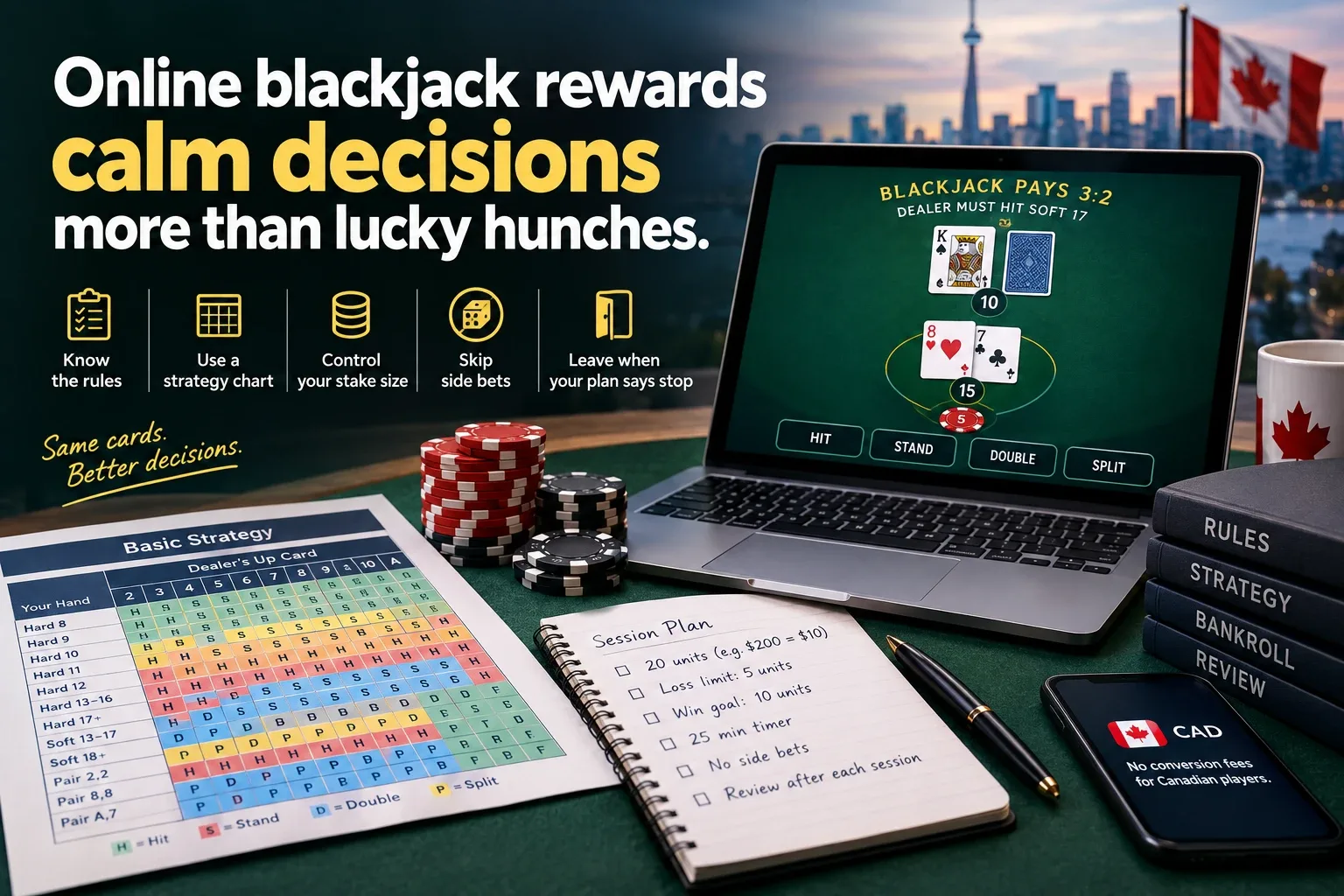
Top Strategies for Winning at Online Blackjack
Blackjack is one of the few casino games where skill genuinely matters. Unlike slots or roulette, the house edge in blackjack can be squeezed down to a fraction of a percent when you play correctly. While no strategy guarantees winnings - the house always retains a small mathematical edge - smart play dramatically reduces that edge and gives you the best possible chance of walking away ahead. Here are the top strategies for winning at online blackjack.
1. Learn and Follow Basic Strategy
Basic strategy is the single most important tool in blackjack. It's a mathematically proven set of rules that tells you the optimal play - hit, stand, double, split, or surrender - for every possible combination of your hand and the dealer's upcard.
Developed from computer simulations of millions of hands, basic strategy reduces the house edge to roughly 0.5% when applied consistently. A few key examples:
- Always hit a hand of 8 or less.
- Stand on 17 or higher (except hit soft 17 if the dealer's upcard is strong).
- Double down on 11 against any dealer upcard except an Ace.
- Always split Aces and 8s; never split 10s or 5s.
- Surrender 16 against a dealer's 9, 10, or Ace when surrender is offered.
Print a basic strategy chart (readily available online) and consult it while you play. Most online casinos won't object - there's no rule against it, and the chart never changes. Over time, correct decisions will become second nature.
2. Choose the Right Game and Rules
Not all blackjack tables are equal. Rule variations significantly affect the house edge, so pick games with player-friendly conditions:
- Blackjack pays 3:2 - never play a table that pays 6:5; this alone raises the house edge by about 1.4%.
- Dealer stands on soft 17 - better for the player than hitting soft 17.
- Fewer decks - single- and double-deck games generally offer better odds than six- or eight-deck shoes.
- Double down allowed on any two cards, including after splitting.
- Late surrender available - lets you forfeit half your bet on bad hands.
Before sitting down (or logging in), check the table rules. Selecting the right game is one of the easiest "wins" available to you.
3. Understand the Difference: Live Dealer vs. RNG Games
Online blackjack comes in two forms, and each demands awareness:
- RNG (random number generator) games use a freshly shuffled virtual deck for every hand. Card counting is useless here, but basic strategy still applies in full.
- Live dealer games stream a real dealer and a real shoe. Card counting is theoretically possible, though continuous shuffling machines and frequent reshuffles usually neutralize it.
If you enjoy counting cards, live dealer games with deep deck penetration are the only online format where it has any relevance. Otherwise, focus your energy on perfect basic strategy and disciplined bankroll management.
4. Manage Your Bankroll Like a Professional
Strategy at the table means little if you go broke between sessions. Solid bankroll management:
- Set a dedicated blackjack budget you can afford to lose, separate from everyday money.
- Bet no more than 1–2% of your bankroll on a single hand.
- Set win and loss limits for each session (e.g., stop after winning 30% or losing 50% of your session budget) and stick to them.
- Never chase losses by increasing bets to "get it back" - this is the fastest route to emptying your account.
Flat betting (wagering the same amount every hand) combined with basic strategy gives you the longest, lowest-variance ride. Progressive betting systems like Martingale can be entertaining, but they don't overcome the house edge and carry a risk of catastrophic losses.
5. Avoid Side Bets and "Insurance"
Online casinos love side bets - Perfect Pairs, 21+3, insurance - because they carry house edges of 3% to 10% or more. They may look like fun shortcuts, but they erode your expected value hand after hand.
Insurance in particular is marketed as protection, but it's simply a bet that the dealer's hole card is a 10 - a bet with a house edge of about 7.5%. Basic strategy says decline it every time (with the sole exception of card counters in very specific situations).
6. Exploit Bonuses and Promotions - Carefully
One genuine edge online players have over their land-based counterparts is bonuses. Welcome offers, deposit matches, and cashback can temporarily shift expected value in your favor. But always read the terms:
- Check the wagering requirements and whether blackjack contributes to them (it often contributes only 10% or is excluded entirely).
- Verify the maximum bet allowed while a bonus is active.
- Look for blackjack-specific promotions or cashback on live tables.
A well-chosen bonus with fair terms effectively lowers your cost of play. A badly chosen one locks your money behind impossible conditions.
7. Play at Reputable, Licensed Casinos
No strategy survives a rigged or dishonest game. Play only at casinos licensed by recognized regulators (Malta Gaming Authority, UK Gambling Commission, Gibraltar, or similar), which audit their games for fairness. Check that the site publishes its RNG certification and payout rates, and read player reviews before depositing.
8. Keep Your Head: Psychology and Discipline
Blackjack is a game of streaks - in both directions. The strategic edge goes to players who stay level-headed:
- Don't let emotions dictate bet sizes.
- Take breaks when frustrated or tired; fatigue leads to basic-strategy mistakes.
- Accept that short-term results are noise; correct decisions are the only thing you control.
- Never gamble borrowed money or funds you need elsewhere.
Winning at online blackjack isn't about finding a secret system - it's about stacking small, correct decisions. Choose games with good rules, play flawless basic strategy, manage your money with discipline, and take advantage of fair bonuses. You'll shrink the house edge to its minimum and maximize your chances of a winning session. And always remember: blackjack should be entertainment first. Set your limits, play responsibly, and enjoy one of the most intellectually rewarding games the casino has to offer.